

|
Getting your Trinity Audio player ready...
|

Nothing says “Happy Valentine’s Day” like a story about the end of the world.
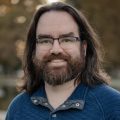
Although there are romance subplots, San Ramon author Greg Le Sage’s debut novel is really more about the gravity and tension its grabber title implies: “Quantum Eschaton”.
“The story explores themes of trust, ambition and the ethical perils of advanced technology in a shadowy, high-stakes world,” Le Sage told me in an email interview over the weekend.
“Eschaton means the final event in the divine plan … A synonym is day of judgment. The story is about the calamity produced by the advent of quantum computing used by bad actors,” said Le Sage, whose day job is engineering at Stanford University.
“A lot of people need to look it up,” he added. “I think it’s beneficial to read the title and ask at first, ‘What does that mean?’ I think it’s a good hook.”
A cyber-thriller that was published in October, “Quantum Eschaton” centers on the aftermath of engineer James Cathcart — “brilliant yet socially isolated,” as Le Sage put it — making a groundbreaking discovery in quantum computing.

“His achievement catches the attention of Seth, a charismatic but morally ambiguous executive, who manipulates James into a dangerous plan,” the author explained. “Seth convinces James to steal the technology, promising wealth and luxury. Together, they orchestrate a heist, using James’s quantum breakthrough to steal £100 million from the Bank of England.”
“They leave the US and try to sell quantum computing to the highest bidder. Potential customers include China, Russia and North Korea,” Le Sage said. “As the plot unfolds, James grapples with moral dilemmas, manipulation and his longing for acceptance, while Seth’s calculated leadership steers them closer to the point of no return.”
“The heist’s repercussions are far-reaching, igniting suspicion, global scrutiny and the realization that quantum technology could upend society’s most secure systems,” he added. “James, a tragic figure desperate for recognition and belonging, becomes an unwilling pawn in a dangerous game of power and betrayal.”
For Le Sage, who also worked at Lawrence Livermore National Laboratory from 1997 to 2007 and then spent 16 years with the CIA’s chief scientist, the story idea sparked from his observations at the federal SLAC National Accelerator Laboratory at Stanford.
“In the last four years, two top engineers were hired away by Amazon and Google. I understand that their salaries were doubled,” he said. “It made me think about how companies would use the talents of top scientists. Scientists at SLAC want to make discoveries. Companies want to make money.”
He began to mold the story in script-writing classes through UCLA, his alma mater. After realizing the chances of selling a screenplay were slim, he switched the concept into a novel.
“My daughter, who is a professional writer, suggested a few plot twists that I added,” Le Sage said. “I found a company in India with an editor who helped me clean up parts of the story. They also helped me create the eBook format that I uploaded to Amazon. For not much money I produced a book.”
Le Sage is now working with a publications firm to promote “Quantum Eschaton” and get hardcover copies released. He’s also fleshing out an idea for his next book.
“I am writing a new story about artificial intelligence in the future. My character has a personal AI assistant who talks him into becoming a hitman,” he told me.
When I first connected with Le Sage last month, I had to start with an apology for my response delay, as it had been a while since he sent his initial inquiry. His message got lost in my inbox amid the deluge of emails I receive on a daily and weekly basis.
It happens — and as it turns out, there were several new book announcements from Tri-Valley authors that I’d missed over the previous year or so (plus some that just arrived in recent weeks). We’re working to get them into our coverage queue, but I’ll give a tease here to show the breadth of original writing coming out of our region.
In another example of science meets mystery, Sidney Niemeyer published his debut novel in late 2023, “Atomic Peril: A Nuclear Forensics Thriller”, which centers on a fictional hero scientist at LLNL, where he used to work.
Linda Drattell, who splits her time between Pleasanton and Barcelona (and is a fellow American University alum!), released her newest poetry collection last year. “The Lighter Side of Horse Manure” leverages Drattell’s 31 years of working with horses for creative inspiration on the page.
Dublin resident Monique Rardin Richardson fulfilled a life goal and published her first book of poems, “Pieces of Me”, in October at 59 years old.
Pleasanton’s Sean Kullman, a father and president of the Global Initiative for Boys and Men, took the next step in his efforts by co-writing a book with New York Times best-selling author Michael Gurian that dropped last month, “Boys, A Rescue Plan: Moving Beyond the Politics of Masculinity to Healthy Male Development”.
And Livermore’s John G. Bluck is poised next week to release the latest installment in his Luke Ryder mystery-thriller series, “Headless in London”.
I better get that book profile assignment list settled soon. No time to waste.
Editor’s note: Jeremy Walsh is the editorial director for the Embarcadero Media Foundation’s East Bay Division. His “What a Week” column is a recurring feature in the Pleasanton Weekly, Livermore Vine and DanvilleSanRamon.com.



Why is there something rather than nothing? This fundamental question explores why the universe exists at all rather than an absolute void. When I saw “Quantum Eschaton” my thought was, that the universe peaked.
About a year ago I wrote a paper, on quantum field theory, explained.
So, another take, quantum eschaton can birth a new universe is intriguing and highly theoretical. Quantum eschaton isn’t a wildly recognized scientific concept, but it seems to blend elements of quantum mechanics and eschatology (the study of end times or ultimate destiny).
In scientific terms, theories related to universe creation often involve concepts like the multiverse, quantum fluctuations, and cosmic inflation. Some speculative ideas include:
1. Quantum Fluctuations: At the quantum level, fluctuations in energy fields might potentially create tiny, nascent universes that could expand under the right conditions.
2. False Vaccum Decay: This concept involves a transition from a metastable false vacuum state to a lower energy true vacuum state, potentially triggering the birth of a new universe.
3. Cosmic Inflation: Rapid exponential expansion of the early universe might hint at mechanisms for universe creation, possibly even giving rise to a multitude of universes.
4. Multiverse Theory: The idea that our universe Is one of many existing universes, each with different physical constants and properties.
However, these theories are speculative and far from being experimentally verified or understood.